Acoustic design of schools - Specifying finishes

Why do Classrooms need acoustic absorption?
Bare walls and hard finished ceilings, such as plaster or concrete will lead to 'echoey' classrooms that feel noisy, stressful and cause vocal strain for the teacher. Arguably most importantly, it is harder to hear and understand the teacher and speech intelligibility is likely to be poor.
Approved Document E of the Building Regulations requires that all student spaces in a school do not exceed mid-frequency reverberation time limits, as set out in Section 1.5 of BB93.
Tool for calculating Reverberation time
We have put together a tool for calculating the indicative reverberation time, as required for complying with the relevant BB93 room acoustics criteria. This is intended to provide early design advice for costing and is not a substitute for a formal review by a competent acoustic consultant.
This tool can be found HERE
General rules for specifying finishes
To ensure rooms are suitable for use, the teacher can be heard and teaching spaces are calm environments, rooms will usually require acoustically absorbent finishes.
For most classrooms, where ceilings do not exceed 3 m. the simplest solution is to install an acoustically absorbent ceiling. In almost all cases, a Class A ceiling within a classroom will achieve the BB93 requirements. Exceptions to this are SEN rooms which require more careful consideration. If ceiling height exceeds around 3.3 m, you should be considering acoustic absorption on the walls to reduce repeat reflections between parallel surfaces.
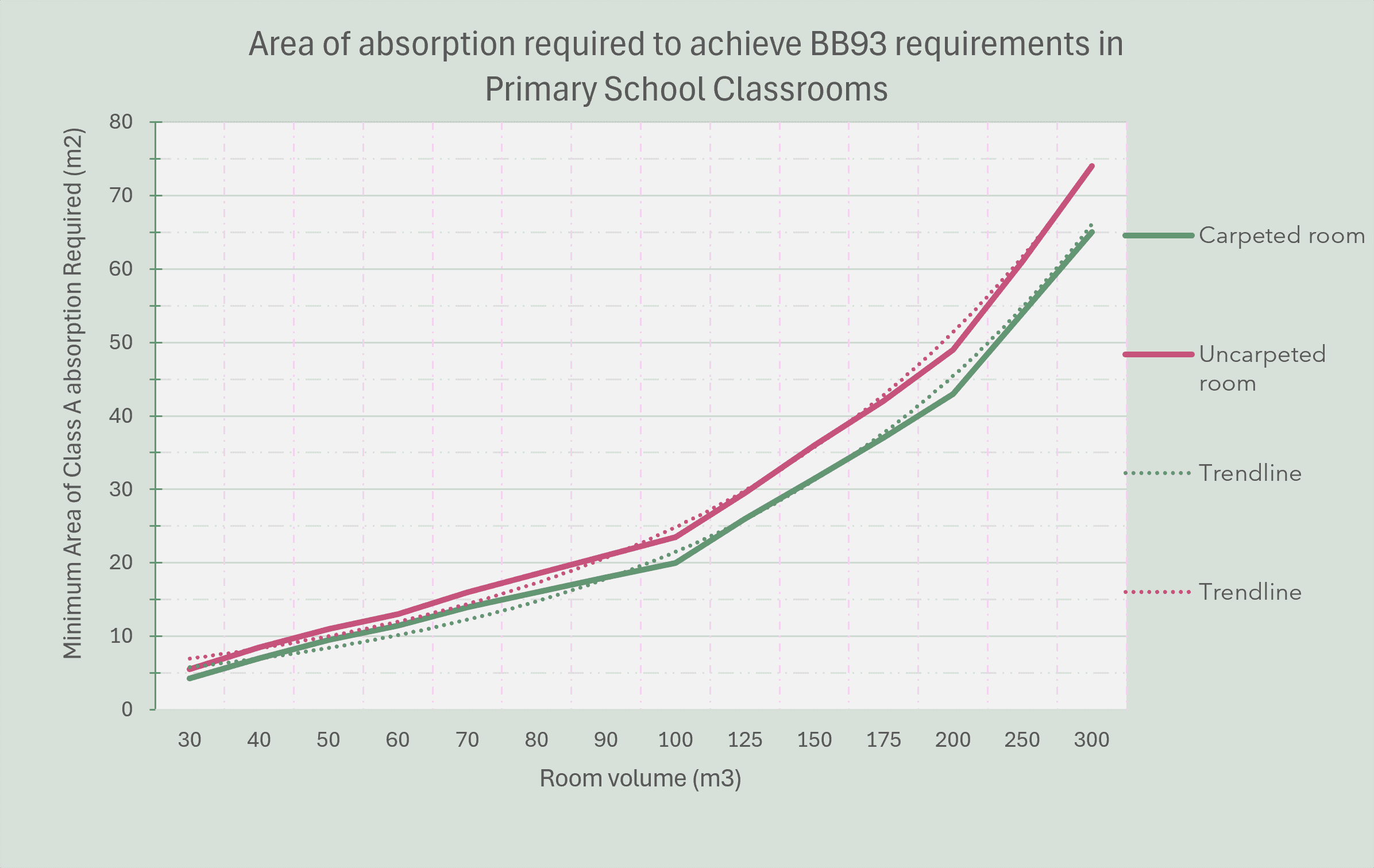
If alternative absorptive finishes are desired, then the following graph can be used to specify area requirements for both wall and ceiling mounted finishes. This graph is indicative and designs should always be checked by a qualified acoustics consultant.
Continue Reading
Explore ideas, trends, and behind-the-scenes stories from our studio.